Last updated: October 8, 2026 — revised for the 67th edition IATA Dangerous Goods Regulations, in force since 1 January 2026.
Direct answer: shipping lithium batteries to UAE means moving Class 9 dangerous goods under the IATA Dangerous Goods Regulations. Lithium metal batteries shipped alone (UN3090, PI 968) are forbidden on passenger aircraft and move Cargo Aircraft Only. Since 1 January 2026, lithium-ion batteries must also be offered at a state of charge no higher than 30%. Every shipment needs UN-specification packaging, correct labels, and a Dangerous Goods Declaration.
Table of Contents
What changed on 1 January 2026
The 67th edition of the IATA Dangerous Goods Regulations became mandatory on 1 January 2026. If you last shipped batteries under the 2025 rules, one change matters more than the rest.
The 30% state-of-charge limit used to apply only to lithium-ion batteries shipped on their own. It now extends to batteries packed with equipment and batteries installed in equipment. A limit that was a recommendation in the 66th edition is now a hard requirement.
Two further changes are worth knowing. IATA added classification guidance for hybrid packs combining lithium-ion and sodium-ion chemistry. And the 67th edition addresses so-called trivial rejections — cargo turned away over cosmetic paperwork faults rather than real safety issues.
Source: IATA Lithium Battery Guidance Document, 2026.
Which UN number applies to your shipment
Most problems start here, before anything is packed. The UN number depends on the chemistry and on whether the batteries travel alone, alongside equipment, or inside it.
| UN number | What it covers | Packing instruction | Passenger aircraft | 2026 state of charge |
|---|---|---|---|---|
| UN3090 | Lithium metal batteries, shipped alone | PI 968 | Forbidden | Not applicable — non-rechargeable |
| UN3091 | Lithium metal, with or in equipment | PI 969 / PI 970 | Restricted | Not applicable |
| UN3480 | Lithium-ion batteries, shipped alone | PI 965 | Forbidden | Mandatory, 30% or less |
| UN3481 | Lithium-ion, packed with or in equipment | PI 966 / PI 967 | Permitted with conditions | Mandatory from 2026 |
| UN3556 | Vehicles powered by lithium-ion batteries | PI 952 | Forbidden | Mandatory above 100 Wh |
Two entries most shippers do not expect to meet: UN3481 covers a laptop, a power tool, or a medical device with the pack installed. UN3556 covers battery-electric machinery, which has its own set of problems by sea — we covered those in shipping electric construction equipment.
State of charge: the rule that catches most shippers
State of charge is how full the battery is when it is handed to the airline, expressed as a percentage of its rated design capacity. A lower charge means less stored energy and a smaller fire if something goes wrong. That is the whole logic behind the rule.
From 1 January 2026 the battery must be offered at 30% of rated design capacity or less, or show an indicated capacity of 25% or less. Shipping above that threshold is not impossible, but it requires written approval under Special Provision A331 from both the State of Origin and the State of the operator — a process measured in weeks, not days.
Where this bites in practice: a shipper sends brand-new devices straight from the factory, fully charged because that is how they were assembled and tested. The cargo is correct in every other respect and still gets rejected at acceptance. Discharging a pallet of devices at the airport is not an option, so the shipment goes back.
Lithium metal batteries under UN3090 are not rechargeable, so the state-of-charge rule does not apply to them. If your shipment is purely UN3090, this section is background rather than a to-do.
Shipping lithium batteries to UAE: the 5-step process
- Pickup from the shipper. Collection direct from your facility, with the cargo under controlled handling from the first move rather than passing through a general parcel network.
- Packing in UN-specification boxes. Certified packaging rated for the contents, protecting against shock, vibration, and short circuit. Terminals are the strongest and the batteries cannot move inside the box.
- Labeling and marking. Cargo Aircraft Only label, Class 9 lithium battery hazard label, and the UN number on every package. Size and placement are specified, not a matter of preference.
- Dangerous Goods Declaration and Air Waybill. The DGD states the UN number, proper shipping name, packing instruction, net quantity, and packaging specification. The Air Waybill carries matching dangerous goods entries. Without both, no airline will load the cargo.
- Delivery to JFK and airline handover. Cargo delivered to the terminal and presented at the airline’s dangerous goods desk, where the documents and the physical packages are checked against each other before acceptance.
What goes wrong when it is done badly
The failure modes are predictable and all of them cost money.
- Rejection at acceptance. The airline’s DG desk refuses the cargo and it goes back to the shipper. Freight charges are not refunded.
- Mismatch between paperwork and packages. A net quantity on the DGD that does not match what is in the box is the most common single fault.
- Delay at Dubai customs. The UAE applies dangerous goods rules strictly on import, and a shipment held at destination accrues storage while it is resolved.
- Penalties. Misdeclaration of dangerous goods is a regulatory offence, not an administrative slip, and liability sits with the shipper.
The JFK to Dubai route
JFK is one of the few US gateways with daily dangerous goods capacity to the Gulf, which is why it is the practical origin for most East Coast battery shipments even when the cargo starts elsewhere.
The UAE side is strict by design. Dubai handles enormous volumes of electronics and industrial cargo, and dangerous goods acceptance there is checked rather than assumed. A file that would pass unexamined on a domestic US move gets read line by line.
Plan the schedule around approval, not around flight time. The flight is roughly fourteen hours. The dangerous goods booking, acceptance checks, and documentation review are what actually set the delivery date.
What Falcon Cargo does, and what stays with you
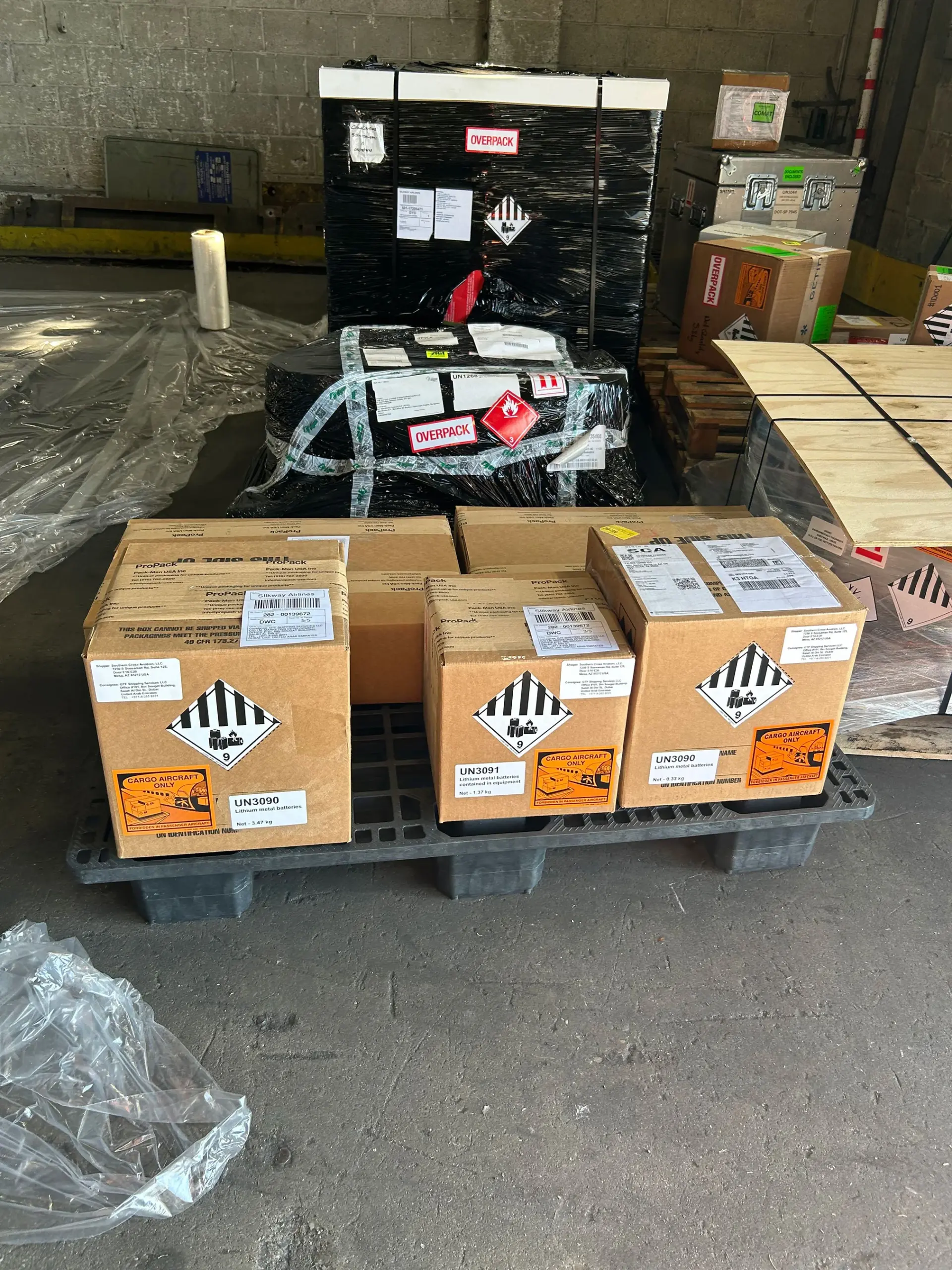
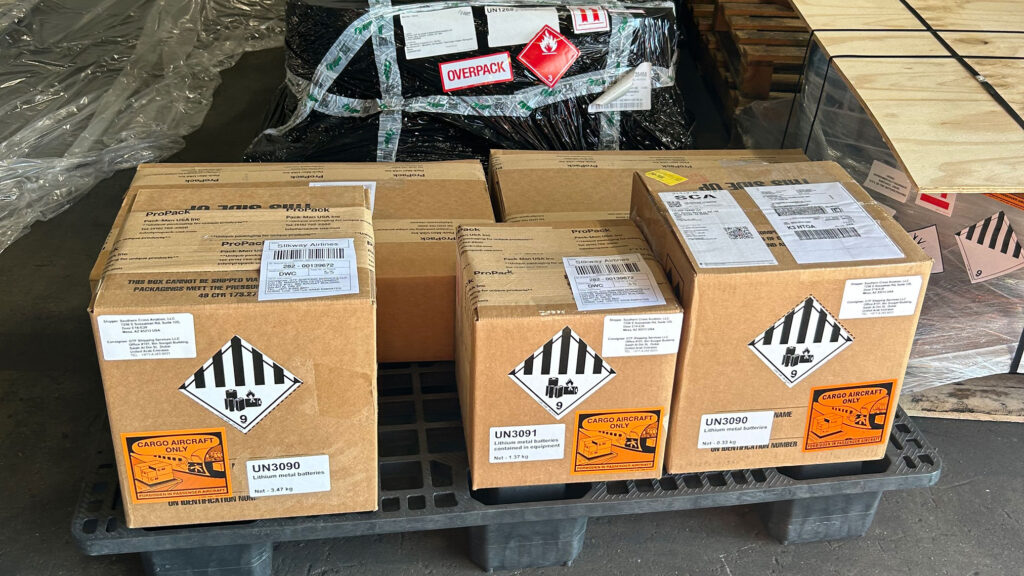
Falcon Cargo arranges and prepares lithium battery shipments from the USA and Canada: pickup, UN-specification packing, labeling, preparation of the Dangerous Goods Declaration and Air Waybill, delivery to the terminal, and coordination with the airline’s dangerous goods desk through acceptance. The photo above is one of our own UN3090 shipments prepared at JFK for Dubai.
What cannot be handed over is the underlying responsibility. Classification of your product, the UN 38.3 test summary, the accuracy of what is declared, and the condition of the batteries themselves remain the shipper’s obligation under the regulations. We will tell you when a shipment needs a decision we are not the right party to make, and that answer is sometimes that the cargo should not fly at all.
Send the battery specification — chemistry, watt-hours or lithium content, quantity, and whether they travel alone or inside equipment — and the destination airport to get a freight quote. Our air and ocean freight services cover the rest of the export chain once the cargo is cleared to move.
People also ask
Can lithium batteries be shipped to Dubai on a passenger plane?
Lithium metal batteries shipped alone under UN3090 are forbidden on passenger aircraft and travel Cargo Aircraft Only. The same applies to lithium-ion batteries shipped alone under UN3480. Batteries installed in equipment under UN3481 can travel on passenger aircraft subject to the packing instruction conditions.
What is the 30% state of charge rule?
Lithium-ion batteries must be offered for air transport at no more than 30% of rated design capacity, or an indicated capacity of 25% or less. Mandatory since 1 January 2026 under the 67th edition IATA DGR, and now covering batteries packed with and installed in equipment, not only batteries shipped alone.
Do I need special approval to ship UN3090 lithium batteries?
Not a special permit, but the shipment must meet PI 968 in full: UN-specification packaging, Cargo Aircraft Only labeling, Class 9 hazard labels, and a Dangerous Goods Declaration. The airline makes the acceptance decision at the terminal, and it will refuse cargo that does not match its paperwork.
What labeling is required for lithium battery shipments?
Each package carries the Class 9 lithium battery hazard label, the UN number, and, where the contents are restricted to freighter aircraft, the Cargo Aircraft Only label. Labels must be durable, legible, and applied so they stay visible in transit. Sizes are specified in the regulations and differ between label types.
How do I know which packing instruction applies?
It depends on chemistry, on watt-hour rating or lithium content, and on whether the batteries ship alone, with equipment, or inside it. Lithium-ion alone is PI 965, lithium metal alone is PI 968, and in-equipment variants fall under PI 966, 967, 969, or 970. The rating of the individual cell or battery decides the section, but the net quantity per package is capped separately and does count cumulatively.
Can lithium batteries travel with other dangerous goods?
Not with incompatible classes. Lithium batteries cannot be packed together with flammable gases or liquids, explosives, or oxidizers. Segregation rules apply across the whole consignment, so a single incompatible item can stop an otherwise correct shipment.
Can I ship damaged or recalled lithium batteries by air?
No. Batteries identified as damaged, defective, or subject to recall for safety reasons are forbidden from air transport. There is no packaging or paperwork route around this. Damaged packs need surface transport under separate rules, or disposal through a licensed recycler.
How far in advance should a battery shipment be booked?
Allow more time than for general cargo. Dangerous goods bookings need carrier approval before space is confirmed, and documents are reviewed before acceptance. Where a state-of-charge approval under Special Provision A331 is required, add weeks rather than days.
Ready to ship? Let’s talk.
Falcon Cargo handles commercial exports from the USA and Canada — air and ocean, any complexity, any destination.
Website: https://falconcargo.net
Email: sales@falconcargo.net