Heavy equipment export from the USA or Canada comes down to three things: choosing the right vessel mode for the machine, filing the export paperwork on time, and getting every unit to the port before cutoff. The ocean leg is rarely where things break. Most delays start earlier, with a missing bill of sale, a late AES filing, or a dozer still parked at an auction yard when the vessel closes.
This guide covers how excavators, dozers, wheel loaders, drilling equipment, and generators move out of North America. It explains which rules apply to used machinery and where shipments usually lose time and money.
Table of Contents
What Heavy Equipment Export Actually Involves
Heavy equipment export is the process of moving machinery that is too large, too heavy, or too irregular for standard freight from a seller’s location to a foreign port. That covers construction machinery, mining equipment, oil and gas units, drilling rigs, turbines, and generators. Genuine parts for CAT, Komatsu, and Volvo fleets often travel with the units or separately.
A typical shipment has four moving pieces: the machine, its paperwork, the inland haul, and the vessel booking. Each one has its own deadline, and they rarely line up on their own. When a buyer purchases three machines from three different yards, someone has to make those dates fit a single sailing.
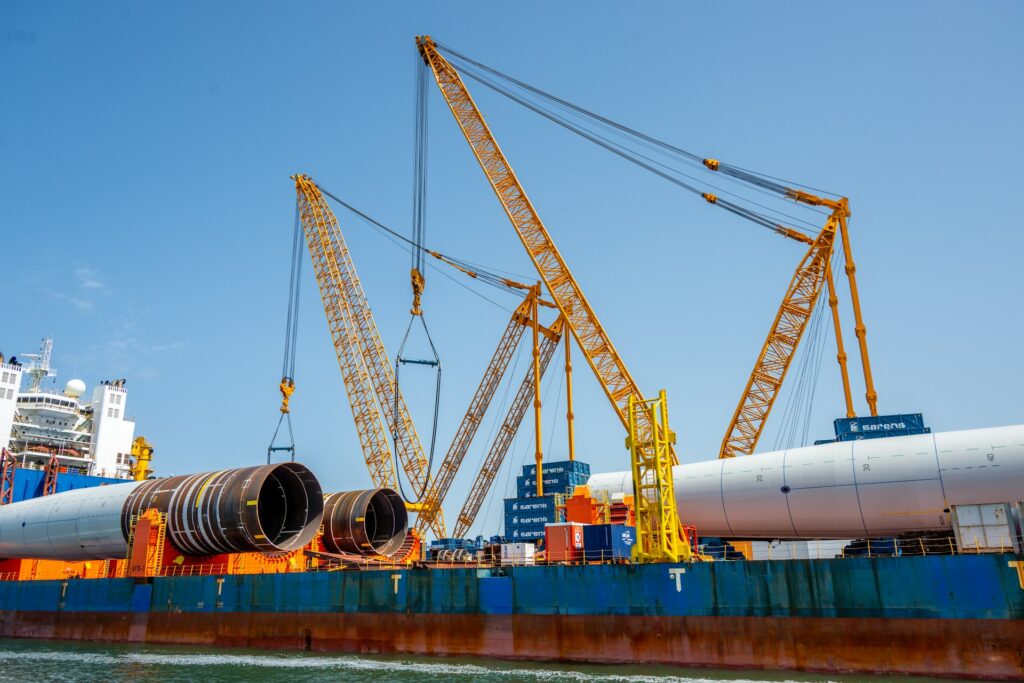
RoRo, Flat Rack, or Breakbulk: Choosing the Mode
The machine decides the mode more than the budget does. Whether the unit runs, how tall and wide it is, and whether it can be split into parts narrows the options fast.
| Mode | Best fit | How it loads | Watch for |
|---|---|---|---|
| RoRo | Self-propelled or towable units: wheel loaders, graders, trucks, tracked machines that run | Driven or towed aboard | The machine must start and move under its own power or on a rolling trailer |
| Flat rack | Non-running units and cargo that is over-width or over-height for a standard box | Crane-lifted, then lashed and braced | Lashing plan, weight distribution, and lift points need to be confirmed before pickup |
| Open top | Over-height cargo that still fits the container’s width | Loaded from above by crane | Height above the container is limited by stowage position |
| Standard container | Parts, attachments, smaller machines, or units partly dismantled | Forklift or crane, blocked and braced inside | Dismantling must be documented so the buyer can reassemble |
| Breakbulk | Project cargo beyond flat rack limits: rig modules, large transformers, turbine sections | Lifted by ship or port crane, stowed individually | Fewer sailings, longer planning, port must handle the lift weight |
Route matters too. RoRo service does not reach every port, and some destinations only see breakbulk calls a few times a month. The right answer for a loader going to the Gulf can be wrong for the same loader going to West Africa.
Export Documentation for Used Machinery: AES and the 72-Hour Rule
Used machinery carries stricter export rules than most commercial cargo. Under US Customs and Border Protection (CBP) regulations, self-propelled construction equipment counts as a “used self-propelled vehicle,” the same category as trucks and tractors.
AES filing regardless of value
For most commercial exports, Electronic Export Information (EEI) is filed in the Automated Export System (AES) when a single Schedule B line exceeds $2,500 or when a license is required. Used self-propelled vehicles are an exception. The Foreign Trade Regulations (15 CFR Part 30) require an AES filing for every used self-propelled vehicle, regardless of value or destination.
The 72-hour rule
The filing must be made at least 72 hours before export, not the usual window before vessel loading. CBP also requires the ownership documents and the Internal Transaction Number (ITN) generated by AES to be presented at the port of export at least 72 hours ahead. CBP’s guidance on exporting motor vehicles lays out the details.
In practice, this means the paperwork has to be complete days before the machine reaches the terminal. A unit that arrives on time but without documents sits on the dock and misses the sailing.
What the file usually needs
| Document or step | When it applies | Deadline |
|---|---|---|
| AES filing (EEI), which generates the ITN | Every used self-propelled unit, regardless of value. Other cargo when a Schedule B line exceeds $2,500 or a license is required | At least 72 hours before export for used self-propelled units |
| Original title, or original bill of sale for untitled equipment | Used self-propelled units, presented to CBP together with the ITN | At least 72 hours before export |
| Serial number or Product Identification Number (PIN) | Every machine, matched to the unit itself and to the AES record | Before the AES filing |
| Commercial invoice and packing list | Every shipment, with accurate weights and dimensions | Before booking and filing |
| Schedule B and export control classification | Every shipment. Most machinery is EAR99, but not all | Before the AES filing |
| End-user information and screening against the Consolidated Screening List | Every party to the transaction | Before any commercial commitment |
| Oversize and overweight permits | Inland moves over legal road limits, issued by each state or province on the route | Before the truck is dispatched |
| Destination cleaning or inspection documents | Set by the destination country. New Zealand, for example, requires a cleaning certificate for used outdoor machinery | Before loading |
Falcon Cargo handles the AES filing and the 72-hour presentation as part of the export file, so the timing is managed against the actual sailing date.
Heavy Equipment Export, Step by Step: From the Vendor’s Yard to the Vessel
The sequence below applies whether the cargo is a single excavator or a fleet bought from several sellers.
- Collect specs. Make, model, serial number, operating weight, dimensions with attachments, and whether the unit runs. Wrong dimensions are the most common reason a booking gets rejected at the terminal.
- Choose mode and routing. Match the machine to RoRo, flat rack, container, or breakbulk, then check which carriers actually serve the destination port.
- Confirm readiness at every pickup location. Verify that the seller has released the unit, that payment has cleared, and that loading equipment is available at the yard.
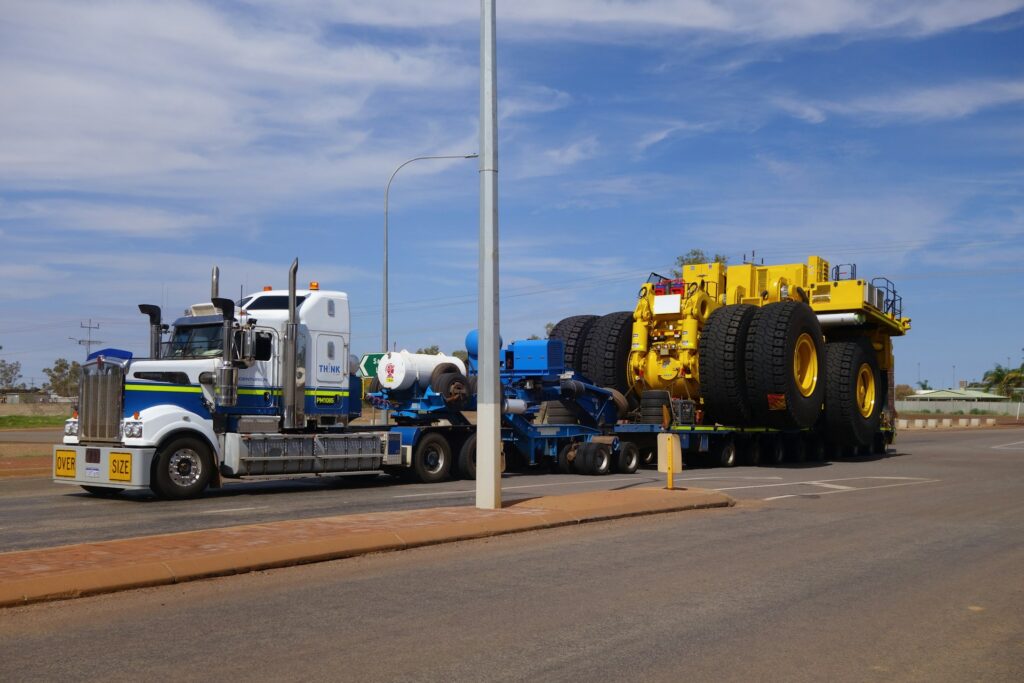
- Arrange inland transport and permits. Oversized and overweight loads move on lowboy or RGN trailers under state or provincial permits, sometimes with escort vehicles and route restrictions.
- File export documents. AES filing, ITN, ownership documents, and the 72-hour presentation for used self-propelled units.
- Terminal delivery and securing. Delivery inside the receiving window, then lashing, bracing, or RoRo stowage according to carrier requirements.
- Departure and handover. Bill of lading release, status updates through transit, and documents sent to the consignee’s broker ahead of arrival.
Cargo insurance for the transit can be arranged as part of the shipment. Pre-shipment inspections and condition reports are handled through independent surveyors at the seller’s location.
Where Heavy Equipment Logistics Goes Wrong
Most problems in heavy equipment logistics are timing problems. They show up as fees, not as damage.
Misaligned readiness dates
A buyer purchases a dozer at an auction in Texas, a loader from a dealer in Ohio, and parts from a supplier in Ontario. Each seller has a different release date and a different idea of “ready.” If one unit is late, the whole group either waits for the next sailing or ships in pieces at a higher cost.
Missed cutoffs
Terminals close cargo receiving before the vessel departs, and documentation cutoffs often fall earlier. For used self-propelled units, the 72-hour rule pushes the paperwork deadline even further ahead of loading.
Storage, demurrage, and detention
A machine that arrives at the port too early pays storage. A flat rack held too long pays demurrage or detention. Both charges add up by the day, and neither is visible in the original freight quote.
Wrong dimensions
A dimension sheet that leaves out a bucket, ripper, or counterweight changes the permit, the trailer, and sometimes the vessel mode. It is cheaper to measure twice at the yard than to rebook at the terminal.
Each of these comes back to one question: who is responsible for the whole chain? Falcon Cargo coordinates sellers, trucking, documents, and booking as one process, so dates are planned against each other instead of separately. See our export services for the full scope.
Destination Rules That Stop Machinery on Arrival
US export clearance is only half the job. The destination country can refuse a machine that left the US legally.
Biosecurity rules are the clearest example. Australia requires all used machinery to arrive free of soil, seeds, and plant or animal material, and every unit is declared and inspected. The Australian Department of Agriculture’s cleanliness standards state that machinery failing them may be refused entry. A rejected machine gets re-exported or cleaned at the importer’s expense, which adds freight, cleaning, and weeks of delay.
New Zealand applies similar requirements, and other markets have their own rules on equipment age, emissions, or pre-shipment inspection certificates. Washing is done at third-party washpad facilities or approved port locations before loading. We coordinate that step with the shipment schedule, but the requirement itself is set by the destination and should be checked before the machine is purchased.
When Air Freight Makes Sense
Complete heavy machines and rigs move by sea. Air freight is for the parts that keep them running: hydraulic pumps, final drives, engine components, control modules, and other critical spares for a machine that is down on site.
Air cost is driven by chargeable weight, so it works for compact, high-value parts and rarely for anything that needs a crane to lift. For urgent shipments, charter options exist when scheduled capacity cannot carry the piece in time. More on how Falcon Cargo works across air and ocean exports.
People Also Ask
How do you export heavy equipment from the USA?
Collect accurate specs, choose RoRo, flat rack, container, or breakbulk, and arrange permitted inland transport to the port. File the export in AES, present ownership documents to CBP, and deliver the unit to the terminal before cutoff. Used self-propelled machines must be filed and documented at least 72 hours before export.
Do used excavators need an AES filing?
Yes. CBP treats self-propelled construction equipment as a used self-propelled vehicle. Under 15 CFR Part 30, every used self-propelled vehicle requires an AES filing regardless of value or destination. The filing must be made at least 72 hours before export, and the resulting ITN is presented to CBP with the ownership documents.
Should construction equipment ship RoRo or on a flat rack?
RoRo suits machines that run and can be driven or towed aboard, and it avoids crane lifts. Flat racks suit non-running units and over-width or over-height cargo that needs crane loading and lashing. Port coverage matters as much as the machine, since RoRo service does not reach every destination.
Can heavy equipment be shipped by air?
Complete heavy machines almost never fly. Air freight is used for critical spare parts and compact components, such as hydraulic pumps, final drives, or control modules, when a machine is down and waiting for a sea shipment would cost more than the air rate. Charter is an option for urgent oversized pieces.
Ready to ship? Let’s talk.
Falcon Cargo handles commercial exports from the USA and Canada — air and ocean, any complexity, any destination.
Website: https://falconcargo.net
Email: sales@falconcargo.net
Send your equipment specs and destination through our contact page to get a freight quote.
Still sourcing the machine? Our partner LS Projects buys and prepares heavy equipment in the USA and Canada for export.