Key takeaways
- RoRo vs flat rack comes down to one question: does the machine drive? If it rolls under its own power and the destination has a ramp, RoRo is almost always cheaper.
- Flat rack costs more because of crane handling, lashing labor, and lost-slot surcharges on over-width cargo — but it reaches nearly every container port on earth.
- Breakbulk is for what neither can take: units past 50 tons, crawler cranes, rig modules, turbine sections.
- The USTR Section 301 fee on foreign-built vehicle carriers is suspended through November 9, 2026. RoRo bookings after that date carry real reinstatement risk.
Table of Contents
The three methods, defined
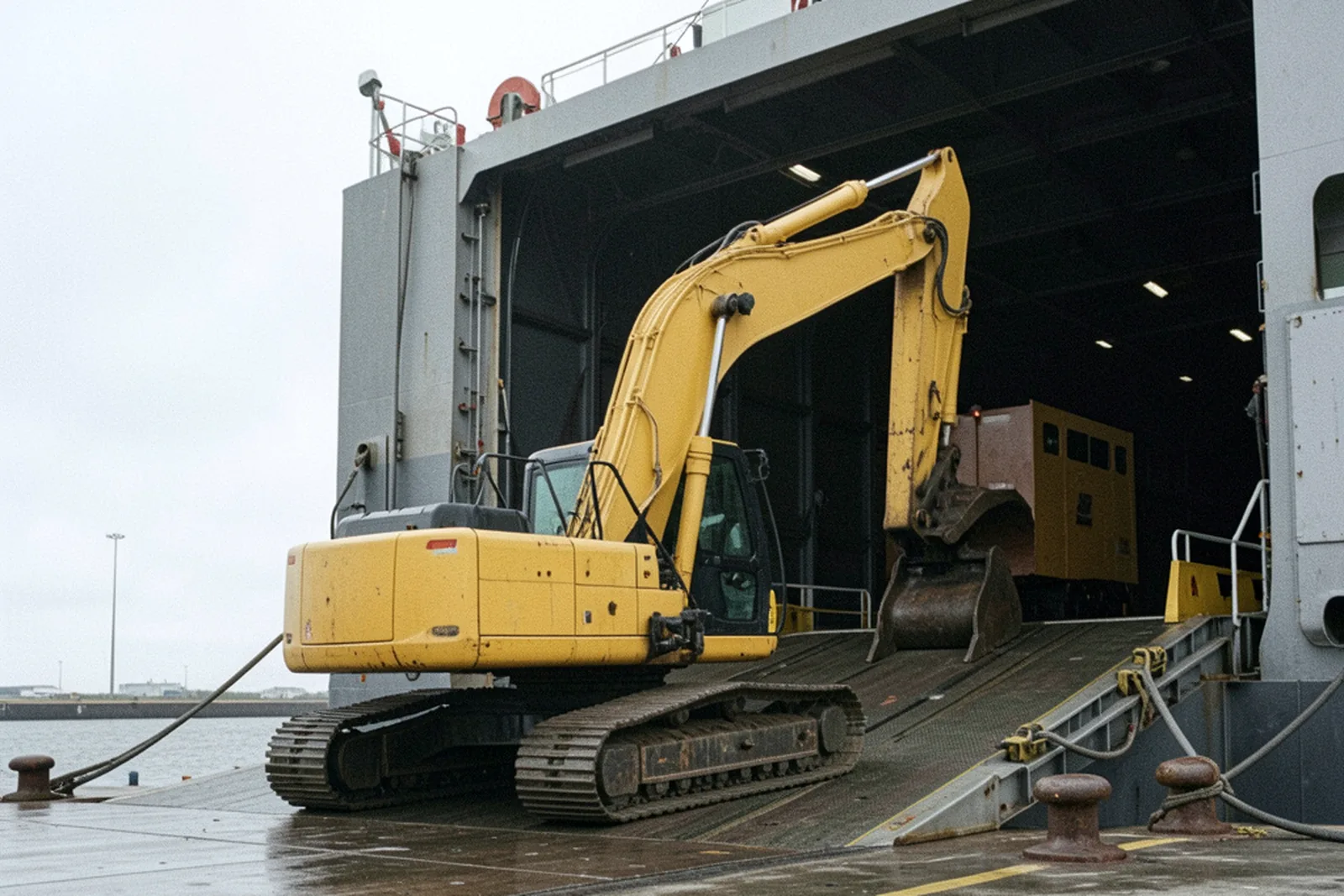
RoRo means roll-on/roll-off. The vessel has a ramp, the machine is driven aboard, lashed to the deck, and driven off at destination. No crane touches it.
Flat rack is a container with a floor and two end walls, no sides and no roof. The unit is lifted on by crane and chained down to lashing eyes. It stows in a normal container slot on a normal container ship.
Breakbulk means the cargo is lifted straight into a vessel’s hold or onto its deck, no container at all. Ship’s gear or shore cranes do the lifting, and the piece is secured in place for the voyage.
The choice is dictated by four things: whether the machine is drivable, its dimensions, its weight, and what the destination port can physically handle. Preference does not enter into it.
RoRo vs flat rack vs breakbulk: side by side
| Factor | RoRo | Flat rack | Breakbulk |
|---|---|---|---|
| Cargo must be | Self-propelled or towable | Liftable, within lashing limits | Any shape, any weight the gear takes |
| Loading | Driven up a ramp | Crane lift onto the rack | Crane lift into hold or onto deck |
| Port coverage | Limited — ramp terminals only | Broad — most container ports | Limited — heavy-lift berths |
| Weather exposure | Enclosed deck on most vessels | Open, tarp or shrink-wrap needed | Open deck or hold |
| Extra charges to expect | Few beyond the base rate | Lashing, OOG and lost-slot surcharges | Heavy-lift, stevedoring, per-ton rating |
| Typical use | Excavators, dozers, tractors, trucks | Over-width or non-running machines | Rig modules, crawler cranes, turbines |
When RoRo wins
If the machine starts, drives, and steers, RoRo should be the first quote you request. You skip the crane lift, you skip the lashing crew, and you skip the surcharges that come with hanging over the edge of a container slot.
The catch is geography. Not every destination has a ramp terminal, and some that do will not accept tracked machines because steel tracks damage deck plating. West Africa and the Gulf are well served. Landlocked destinations and secondary ports in Central Asia usually are not.
Second catch: RoRo sailings on any given lane are less frequent than container services. If your buyer needs the unit in six weeks and the next RoRo sailing is in five, that is your answer regardless of price.
Prepare the unit properly
Fuel drained to roughly a quarter tank, battery connected, keys with the shipping documents, no loose attachments in the cab. Tracked units need track shoes cleaned of dirt — agricultural residue triggers inspection holds at more destinations than most exporters expect.
When flat rack is the only option
Flat rack takes what RoRo cannot: machines that do not run, machines too tall or too wide for the ramp deck, and shipments going to ports with no RoRo service at all. It rides on ordinary container vessels, which means schedule frequency and port choice that RoRo cannot match.
You pay for that access. Published industry figures for a Caterpillar 320-class excavator moving Savannah to Jebel Ali on flat rack put the base rate near $4,500, with roughly $3,200 in out-of-gauge and lost-slot surcharges and about $1,200 for lashing and securing at the terminal — an ocean segment near $8,900 all in. Treat that as a shape, not a quote. Rates move with capacity, season, and booking date.
The surcharge that surprises people is lost slot. When cargo overhangs the rack, the carrier cannot sell the container positions beside or above it, and bills you for the empty space. Two inches of overhang can cost four figures.
Measure before you book, not after
Width, height, and length at the widest point, including the boom, the bucket, and anything that could not be removed. A booking made on catalog dimensions and corrected at the terminal turns into a rebooking, a missed sailing, and storage.
When it has to be breakbulk
Past roughly 50 tons, or with dimensions no rack will hold, breakbulk is what remains. Mining excavators, crawler cranes, drilling rig modules, turbine sections, pressure vessels.
It is slower and more labor-intensive than the other two. Loading is measured in days, not hours. Rates are usually quoted per ton or per cubic meter rather than per unit, and heavy-lift berths exist at a limited set of ports.
The compensation is that breakbulk has no dimensional ceiling in any practical sense. If it can be lifted and secured, it can move.
The fee window closing in November 2026
This is the part worth acting on. Under its Section 301 action on Chinese maritime dominance, USTR set a fee of $46 per net ton on operators of foreign-built vehicle carriers — the vessel class that carries RoRo cargo. Carriers passed it through, and RoRo rates rose 15 to 30 percent depending on the line.
The fee was then suspended for one year as part of a US–China trade agreement. The suspension runs November 10, 2025 through November 9, 2026, and during that window no liability accrues on those fees. Container-carried cargo, including flat rack, sits under different annexes and has largely not seen the charge passed through.
Which means: today, RoRo is priced without that surcharge. In three months it may not be. If you have equipment to move by RoRo and the timing is flexible, booking inside the window is the cheaper decision. If your cargo ships in December, ask your forwarder to quote both RoRo and flat rack, because the gap between them may close.
How to decide in five steps
- Confirm mobility. Does it start, drive, and steer under its own power? No means RoRo is off the table immediately.
- Measure at the extremes. Widest, tallest, longest point with attachments in transport position. Write the numbers down; do not use the brochure.
- Check the destination. Does the discharge port have a RoRo ramp, and does the vessel calling it accept tracked cargo? Many do not.
- Quote both. Get RoRo and flat rack side by side with all surcharges itemized, not a single all-in number.
- Book early. Space for oversized cargo fills first. Four to six weeks out is the working minimum on most lanes.
Four mistakes that cost real money
Booking on catalog dimensions. The spec sheet gives the working configuration. What matters is the shipping configuration, with the boom folded and the bucket off. These are different numbers, and the terminal measures the second one.
Ignoring lost-slot exposure. An all-in flat rack quote that does not itemize OOG surcharges is a quote that will grow. Ask for the breakdown before you accept.
Leaving attachments mounted. Buckets, blades, and rippers that stay on push the unit into a higher over-dimension bracket. Remove them, crate them, ship them alongside.
Sending paperwork after the cargo. A hold at the port runs on demurrage and detention clocks that do not pause. Documents should be with the consignee and the destination broker before the vessel arrives, not while the unit sits.
Where Falcon Cargo fits
We quote RoRo, flat rack, and breakbulk against the same shipment so the comparison is real rather than theoretical. That includes AES filing, export documentation, trucking from the vendor’s yard, packing and bracing, and terminal coordination through departure.
For clients who also need the equipment bought inside the USA, LS Projects handles sourcing and purchase under its own name, and hands the prepared cargo to us. Separate companies, one process from the vendor’s yard to your port. Send dimensions, weight, and destination port and get a freight quote, or read how the sourcing and export process works end to start.
People also ask
Is RoRo cheaper than flat rack for an excavator?
Usually yes, if the excavator drives and the destination has a RoRo terminal. RoRo avoids crane handling, lashing labor, and out-of-gauge surcharges, which together can add several thousand dollars to a flat rack booking. When the machine does not run or the port has no ramp, flat rack becomes the cheaper option by default.
What is a lost slot surcharge?
When cargo on a flat rack overhangs the container footprint, the carrier cannot sell the neighboring or overhead container positions. It bills the shipper for those blocked slots. On an over-width excavator the charge often runs into thousands of dollars, which is why exact measurements matter before booking.
Is the USTR RoRo fee still suspended?
Yes. The Section 301 service fee on foreign-built vehicle carriers is suspended from November 10, 2025 through November 9, 2026, following a US–China trade agreement. No liability accrues during that window. What happens after November 9, 2026 has not been settled, so RoRo bookings past that date carry reinstatement risk.
Can I ship machinery with fuel in the tank?
Only a small amount. Most carriers require the tank drained to roughly a quarter or less for RoRo, since the unit must be drivable but the fuel load is a fire risk. For flat rack and breakbulk, expect requirements to be stricter, and confirm the specific carrier’s rule before the unit leaves the yard.
How far in advance should I book oversized cargo?
Four to six weeks on most lanes. Vessel space for out-of-gauge and heavy cargo is limited and fills before general container space. Late bookings land in the spot market, where rates for oversized units move sharply and sailing options narrow to whatever is left.
Ready to ship? Let’s talk.
Falcon Cargo handles commercial exports from the USA and Canada — air and ocean, any complexity, any destination.
Website: https://falconcargo.net
Email: sales@falconcargo.net