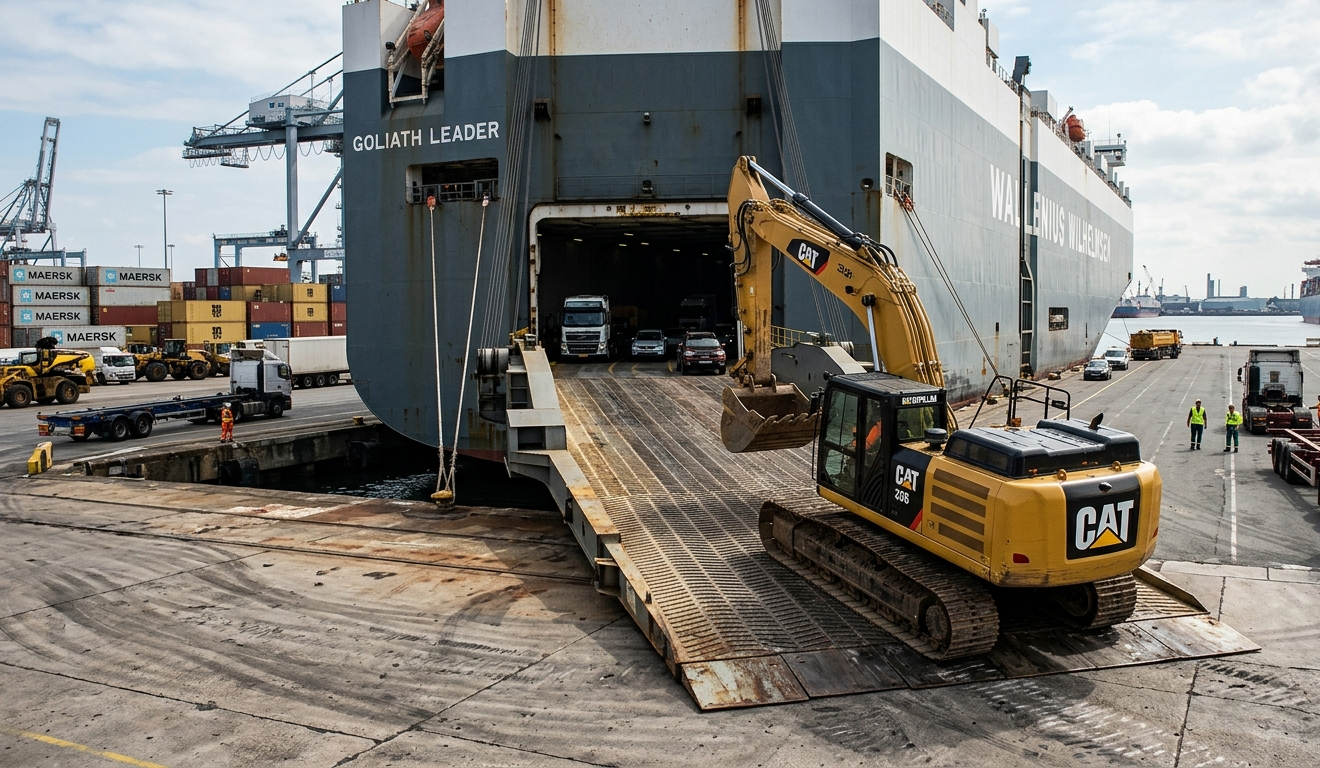
When you need to export heavy equipment from USA, the first decision is not which carrier or which port — it is which loading method fits the machine. The wrong choice adds cost, delays the shipment, or gets rejected at the terminal. Construction equipment, mining machinery, drilling rigs, and industrial units each move differently, and the method that works for a CAT 320 excavator does not necessarily work for a 90-ton crane. Everything you need to know about exporting equipment from the US starts with choosing the right loading method — this guide covers all four options, costs, ports, and required documentation.
Jump to a section:
Table of Contents
The 4 Ocean Freight Methods for Heavy Equipment Export from USA
Heavy equipment and machinery move from US ports by four primary ocean methods. The right one depends on the machine’s dimensions, weight, whether it runs under its own power, and what the destination port can physically handle.
A practical rule: try container first if the unit fits and can be secured properly. If it rolls and the destination has a RoRo terminal, RoRo is usually cheaper. Flat rack handles oversized cargo that a standard container cannot accommodate. Breakbulk is the method when everything else reaches its limit.
Each method carries different costs, lead times, port requirements, and documentation obligations. Getting the decision right at the booking stage prevents expensive corrections later.
RoRo Shipping: Best Method to Export Heavy Equipment from USA That Runs
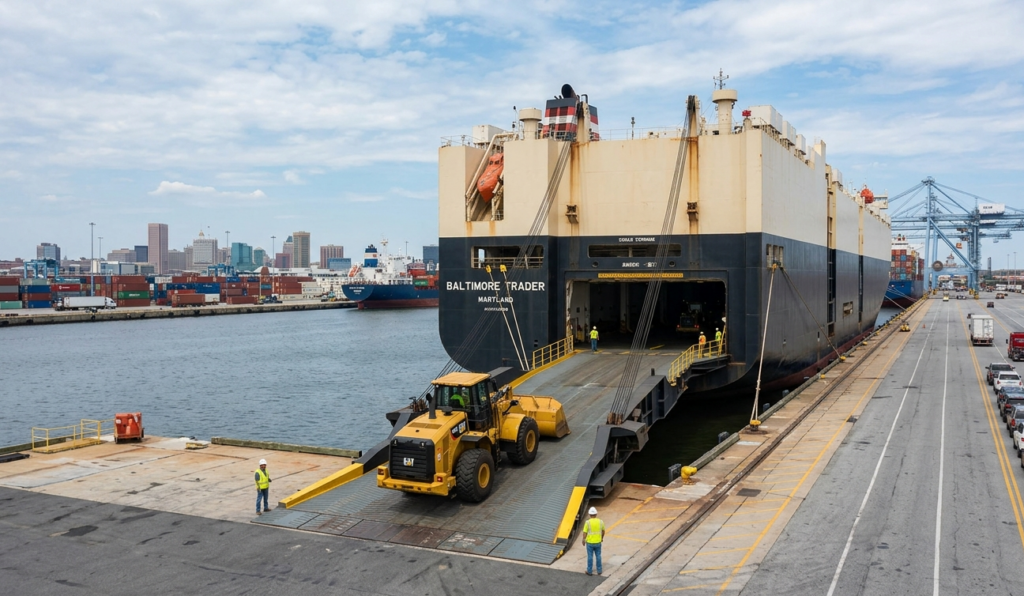
RoRo (roll-on/roll-off) vessels are purpose-built for cargo that can drive or be towed onto the vessel over a built-in ramp. The machine is secured in the vessel’s hold without being lifted, which removes crane charges and most of the rigging complexity. For self-propelled construction equipment — excavators, wheel loaders, bulldozers, motor graders — RoRo is typically the lowest-cost ocean method when the destination port has a RoRo terminal.
When RoRo works
The equipment must be operational or towable. Tracked machinery like excavators qualifies on most RoRo services when the machine can be driven under its own power. The destination port must have a RoRo-capable terminal with ramp access. Not every port does — this is one of the most common booking mistakes on heavy equipment exports to Africa and Central Asia, where RoRo terminal coverage is uneven.
RoRo limitations
Vessel weight limits and deck height restrictions vary by carrier. A CAT 336 or Komatsu PC490 may exceed what a particular vessel accepts on a given lane. Non-running equipment can move via RoRo with forklift handling, but most carriers charge a non-runner surcharge and require confirmation in advance. Width restrictions also apply — over-wide equipment gets rejected at the ramp if not pre-cleared with the carrier.
Flat Rack Containers: Export Heavy Equipment from USA That Is Oversized but Liftable
Flat rack containers are open-frame steel platforms — a floor with fixed end-walls but no sides or roof. They come in 20-foot and 40-foot variants and load by overhead crane rather than ramp. Cargo is secured with chains and turnbuckles to dedicated lashing eyes built into the frame.
When flat rack is the right choice
Flat rack handles equipment that is too wide, too tall, or oddly shaped for a standard container — but not so large that it requires a full breakbulk vessel. A disassembled drilling rig component, an industrial generator, or a mining truck cab typically moves on flat rack. The method travels on regular container vessel schedules, which gives more sailing frequency than breakbulk alternatives on most lanes.
Flat rack documentation and securing
Out-of-gauge cargo on flat racks requires a lashing certificate confirming that securing meets carrier standards. Dimensions and weight must be declared accurately — carriers can reject or re-stow cargo at origin if declared specs do not match actual measurements. For export from USA, the commercial invoice, packing list, and AES/EEI filing apply the same as standard container freight, with the addition of the lashing plan and survey certificate for high-value units.
Breakbulk: For Export Heavy Equipment from USA That Exceeds All Container Options
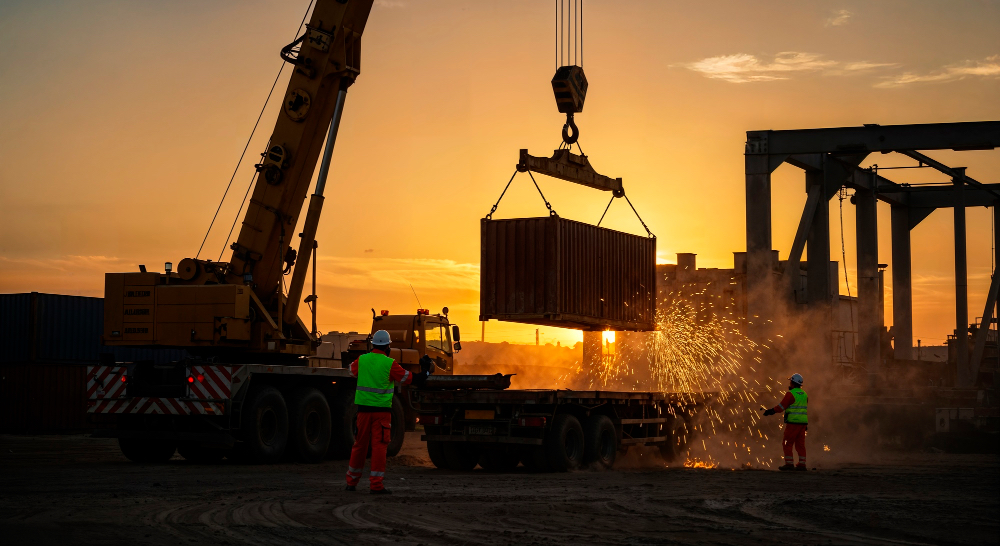
Breakbulk vessels carry cargo loaded individually by crane — not in containers and not on RoRo ramps. This is the method for very large, very heavy, or structurally complex cargo: drilling rigs, industrial turbines, large cranes, transformers, and other project cargo that cannot be safely stowed in any container configuration.
When breakbulk is required
The weight exceeds flat rack payload ratings. The cargo is too wide or too long for safe stow under carrier OOG rules. Complex rigging and engineered lift plans are required before the vessel will accept the cargo. Breakbulk requires more lead time than container or RoRo freight — vessel schedules run less frequently, and port booking windows are tighter. For project cargo of this scale, planning the export 8–12 weeks in advance is standard practice.
US ports with breakbulk and heavy-lift capability
Not every US port handles breakbulk cargo. Houston, Baltimore, Brunswick, Jacksonville, Galveston, New Orleans, Norfolk, and Beaumont handle the majority of heavy-lift and project cargo departures from the US. Port selection affects both sailing frequency to the destination region and the terminal’s crane capacity for the specific unit weight.
FCL Container: Smaller Units and Disassembled Equipment
Standard 40-foot and 40-foot high-cube containers work for compact machinery, equipment that disassembles within container dimensions, and spare parts shipments. A CAT 308 mini-excavator or a set of Komatsu undercarriage components moves more cost-effectively in a standard container than on flat rack.
Disassembly is also a viable option for larger units when mechanics are available and the cost of disassembly plus reassembly at destination is lower than the flat rack or RoRo premium. The trade-off is labor cost at both ends and reassembly risk if destination service capacity is limited. For CAT, Komatsu, and Volvo equipment, parts availability at destination is a real factor in the decision.
US Ports for Heavy Equipment Export
Port selection affects sailing frequency, transit time, and the availability of specialized handling. The main US ports for heavy equipment exports are Houston, Baltimore, Brunswick (Georgia), Jacksonville, Long Beach, Galveston, New Orleans, and Norfolk.
Houston and Baltimore handle the largest share of project cargo and breakbulk departures to the Middle East and Africa. Brunswick and Jacksonville are primary RoRo export hubs for the Southeast and handle high weekly vessel frequency to Europe and West Africa. Long Beach serves Asia and the Pacific. For Central Asia destinations — Kazakhstan, Uzbekistan, Turkmenistan — routing often goes through Black Sea or Caspian feeder ports, which affects the initial US departure point.
Export Documentation Checklist for Heavy Equipment
US export of heavy equipment requires a specific document set. Missing or inaccurate paperwork is the leading cause of port holds and missed sailing cutoffs on machinery shipments.
- Commercial invoice — must include machine make, model, serial number, year, and declared value
- Packing list — dimensions, weight, and any attachments or components included
- AES/EEI filing — required for all US exports above $2,500; filed through the Automated Export System before export
- Bill of lading or sea waybill — issued by the ocean carrier after booking confirmation
- Title or bill of sale — required for self-propelled units (excavators, wheel loaders, trucks); CBP checks this against the AES filing
- Lashing certificate — required for flat rack and breakbulk cargo; confirms securing method meets carrier standards
- ISPM-15 certificate — required when wood crating or wood dunnage is used in the shipment
- EPA Tier compliance documentation — some destination countries require confirmation that the engine tier level meets local import standards
Under the Foreign Trade Regulations, AES filing errors carry penalties starting at $1,100 per violation. For high-value machinery, the AES declaration must match the commercial invoice exactly — discrepancies between declared value and actual machine value are a common trigger for CBP review.
Shipping Costs: What to Expect When You Export Heavy Equipment from USA
Heavy equipment shipping costs from the US typically run between $3,500 and $20,000 per unit depending on machine size, weight, destination, and loading method. These are ocean freight costs — inland transport from the equipment’s location to the export port adds separately, and varies significantly by distance and equipment type.
RoRo is usually the lowest-cost method when it is available. Flat rack adds cost because of the crane lift, specialized securing, and the open-top surcharge that most carriers apply to OOG cargo. Breakbulk is typically the most expensive per unit but may be the only feasible option for very large project cargo.
Storage and demurrage exposure is a particular risk on heavy equipment exports. Terminal free time at US ports typically runs 3–5 days. After that, storage fees apply per unit per day — on heavy equipment, which occupies significant terminal space, these fees add up quickly if a vessel is delayed or documentation holds the cargo at the gate.
Falcon Cargo manages vendor pickup, port coordination, and documentation for commercial heavy equipment exports from the US and Canada. To get a freight quote for your equipment, contact sales@falconcargo.net or visit our services page.
People Also Ask
What is the best method to export heavy equipment from USA?
The best method depends on the equipment type and destination. RoRo is the lowest-cost option for self-propelled machinery when the destination port has a RoRo terminal. Flat rack handles oversized units that cannot fit standard containers. Breakbulk is used for very large or heavy project cargo. Standard FCL containers work for compact equipment or disassembled units.
Which US ports handle heavy equipment exports?
The main US ports for heavy equipment and project cargo exports are Houston, Baltimore, Brunswick (Georgia), Jacksonville, Long Beach, Galveston, New Orleans, Norfolk, and Beaumont. Houston and Baltimore handle the largest share of breakbulk and project cargo departures to the Middle East and Africa. Brunswick and Jacksonville are primary RoRo hubs for Europe and West Africa routes.
What documents are required to export heavy equipment from the USA?
Required documents include: commercial invoice with serial number and declared value, packing list, AES/EEI filing through the Automated Export System, bill of lading, and title or bill of sale for self-propelled units. Flat rack and breakbulk cargo additionally require a lashing certificate. Wood crating requires an ISPM-15 phytosanitary certificate. AES filing is legally mandatory and must match the invoice exactly.
How much does it cost to ship heavy equipment from USA overseas?
Heavy equipment shipping costs from the US typically range from $3,500 to $20,000 per unit for ocean freight, depending on machine size, weight, loading method, and destination. RoRo is usually the lowest-cost option. Flat rack adds a crane and OOG surcharge. Inland transport from the equipment location to the export port is calculated separately based on distance and machine dimensions.
Can a non-running excavator be shipped from USA via RoRo?
Yes, but with limitations. Most RoRo carriers accept non-running equipment with advance notice, but apply a non-runner surcharge and require forklift handling confirmation at the terminal. The machine must be towable. Some carriers restrict non-runners on specific vessel types or lanes. If the machine cannot be moved safely, flat rack or breakbulk becomes the correct method regardless of cost.
People Also Ask
What is the best method to export heavy equipment from USA? It depends on the machine. RoRo is the lowest-cost option for self-propelled equipment when the destination port has a ramp. Flat rack handles oversized units that cannot fit a standard container. Breakbulk is used for very large project cargo. Standard FCL containers work for compact or disassembled units.
Which US ports handle heavy equipment exports? The main ports are Houston, Baltimore, Brunswick (Georgia), Jacksonville, Long Beach, Galveston, New Orleans, Norfolk, and Beaumont. Houston and Baltimore handle the largest share of breakbulk and project cargo to the Middle East and Africa. Brunswick and Jacksonville are the primary RoRo hubs for Europe and West Africa.
What documents are required to export heavy equipment from the USA? Required documents: commercial invoice with serial number and declared value, packing list, AES/EEI filing, bill of lading, and title or bill of sale for self-propelled units. Flat rack cargo requires a lashing certificate. Wood crating requires an ISPM-15 certificate. AES filing is legally mandatory and must match the invoice exactly.
How much does it cost to ship heavy equipment from USA overseas? Ocean freight typically runs $3,500 to $20,000 per unit depending on machine size, weight, loading method, and destination. RoRo is usually the lowest-cost option. Flat rack adds crane and OOG surcharges. Inland transport from the equipment location to the export port is calculated separately.
Can a non-running excavator be shipped from USA via RoRo? Yes, but with limitations. Most RoRo carriers accept non-running equipment with advance notice but apply a non-runner surcharge and require forklift handling at the terminal. The machine must be towable. If it cannot be moved safely, flat rack or breakbulk is the correct method.
Ready to Export Heavy Equipment from the USA?
Falcon Cargo handles commercial heavy equipment exports from the US and Canada — RoRo, flat rack, breakbulk, and FCL, any destination. We coordinate vendor pickup, export documentation, AES filing, port logistics, and departure.