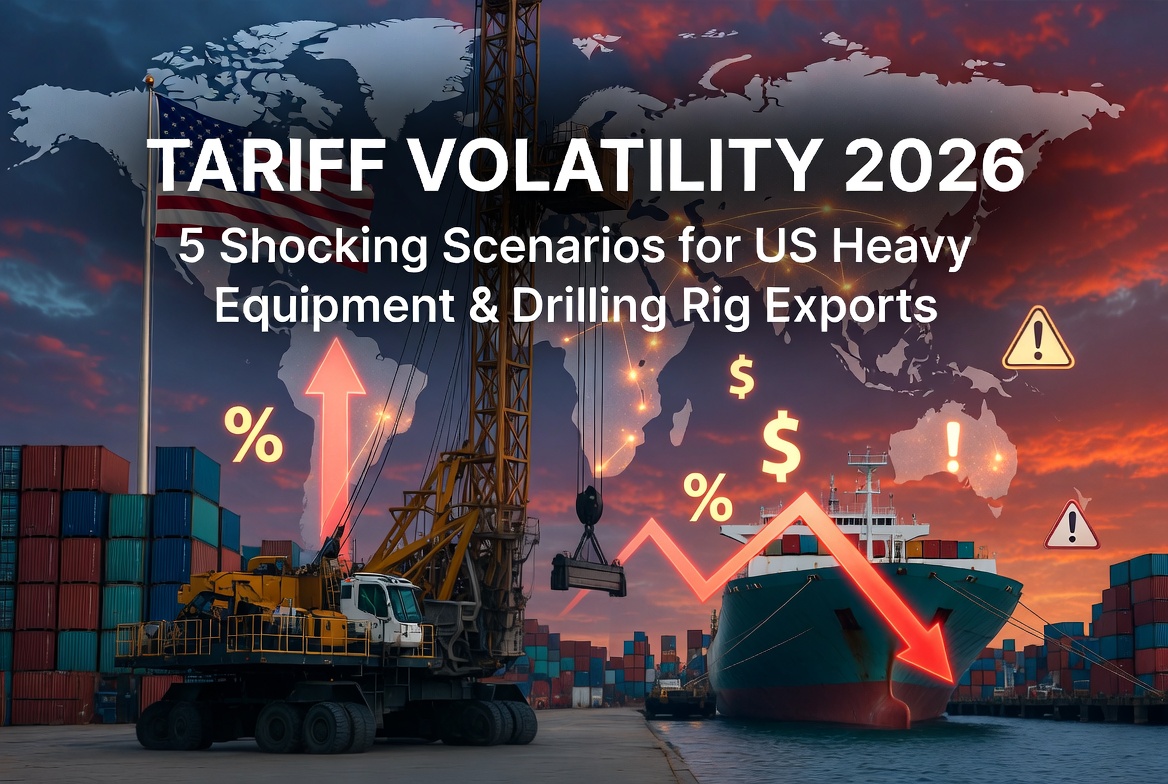
Tariff volatility 2026 has created real uncertainty for every company exporting heavy equipment, drilling rigs, and oversized project cargo from the United States. In February 2026, the Supreme Court struck down Trump’s IEEPA-based tariffs — only for the administration to immediately replace them with Section 122 surcharges. Section 232 and Section 301 duties remain in place. The result: landed cost calculations change faster than contracts can be updated.
At Falcon Cargo, we handle commercial exports of heavy equipment, drilling packages, and oversized cargo from the USA and Canada to the Middle East, Africa, Central Asia, Latin America, and beyond. This guide breaks down what tariff volatility 2026 actually means for your shipments — five real scenarios, a practical USMCA strategy, and a step-by-step compliance checklist you can use today.
Table of Contents
1. What Caused Tariff Volatility 2026 – One Year After Liberation Day.
In early 2025, the Trump administration declared national emergencies over fentanyl trafficking and trade imbalances. Using the International Emergency Economic Powers Act (IEEPA), it imposed tariffs of 10–25% on goods from Mexico, Canada, China, and dozens of other countries — including so-called “reciprocal tariffs” of up to 41% based on perceived trade deficits.
For companies exporting heavy equipment and drilling rigs, the impact was immediate. Foreign buyers faced retaliatory duties from their own governments. US manufacturers importing steel components saw input costs spike. Ocean freight quotes became difficult to finalize because landed cost calculations kept shifting. This is the environment that defined tariff volatility 2026 before the Supreme Court ruling even happened.
2. The Supreme Court Ruling: February 20, 2026
On February 20, 2026, the Supreme Court ruled 6-3 in Learning Resources, Inc. v. Trump that IEEPA does not authorize the President to impose tariffs. Chief Justice Roberts, writing for the majority, held that the word “regulate” in IEEPA cannot be read to include the power to impose tariffs — a power that belongs to Congress under the Constitution’s taxing authority.
The administration responded immediately by issuing an executive order terminating the IEEPA tariffs effective February 24, 2026. More than 2,000 companies have filed refund claims at the Court of International Trade. The refund mechanics remain unresolved — the process will take months or years to work through.
What this means for exporters: The IEEPA tariffs are gone — but refunds are not automatic. If your buyers paid duties on imports of US-made equipment under IEEPA, they may have grounds to file claims. Document all relevant entries now. Work with a licensed customs attorney on timing.
3. Section 122 Replaces IEEPA — What Changed and What Didn’t
Within hours of the ruling, President Trump invoked Section 122 of the Trade Act of 1974, imposing a 10% global import surcharge on most countries — later announced at 15%, the maximum allowed under Section 122. These tariffs are time-limited to 150 days (effective through approximately late July 2026) unless Congress votes to extend them.
What Section 122 does not replace:
- Section 232 tariffs on steel and aluminum — still in effect at 50% on derivatives
- Section 301 tariffs on Chinese goods — still in effect
- USMCA-qualifying goods from Canada and Mexico — exempt from Section 122
The practical result: tariff volatility 2026 continues. The legal basis changed, but the cost exposure for international buyers of US heavy equipment and drilling rigs remains real — and the 150-day clock on Section 122 creates a new decision point in July 2026 that every exporter needs to plan around. This is the most significant global trade update affecting US exporters since the original IEEPA tariffs were announced in early 2025.
4. How Tariff Volatility 2026 Hits US Heavy Equipment and Drilling Rig Exports
US exporters don’t pay import tariffs directly — but tariff volatility 2026 affects outbound shipments through several clear channels:
- Retaliatory tariffs — China, the EU, and other trading partners have imposed duties on US-made goods in response to American tariff actions. Buyers of US drilling rigs in affected markets face higher landed costs, which reduces demand or forces price renegotiation.
- Input cost exposure — Many US manufacturers import steel, components, or subassemblies subject to Section 232 or Section 122 surcharges. Those costs flow through to the FOB price your buyer sees.
- Documentation overload — Every shipment now needs updated HTS classification checks, USMCA qualification review, origin documentation verification, and sanctions screening. The compliance workload has increased significantly since early 2025.
- Routing instability — Tariff changes have forced last-minute port and routing decisions on RoRo, breakbulk, and heavy-lift ocean shipments. Carriers are adjusting schedules, and demurrage exposure has increased.
- Contract risk — Fixed-price export contracts signed before the Section 122 announcement may now expose one party to significant unbudgeted duty costs. Tariff-risk clauses have become standard in new contracts.
5. Five Critical Scenarios for Your 2026 Shipments
Here are five situations that heavy equipment and drilling rig exporters are navigating right now under tariff volatility 2026:
Scenario 1 — Section 122 Expires in July Without ExtensionThe 150-day Section 122 surcharge ends. Buyers in Latin America and the Middle East see landed costs drop and accelerate purchasing decisions. Exporters who pre-positioned equipment at consolidation points near US ports benefit from faster turnaround. The window to close deals at pre-extension rates is short — plan booking timelines now.
Scenario 2 — Congress Extends Section 122 at 15%The surcharge becomes semi-permanent. Buyers in non-USMCA markets face sustained cost pressure. USMCA-qualifying routing via Mexico becomes a significant competitive advantage for equipment that can qualify on regional value content. Exporters who haven’t reviewed their USMCA qualification status on individual product lines are leaving money on the table.
Scenario 3 — Retaliatory Tariffs Shift Destination MarketsA key buyer market — for example, a Gulf state — introduces duties on US-origin heavy machinery in response to American trade actions. The shipment you planned for that market needs to pivot. Having a freight forwarder who can reroute to alternative destinations without losing the vessel booking is the difference between a delayed shipment and a missed project deadline.
Scenario 4 — Input Cost Spike from Section 232 ComponentsYour US fabricator’s imported steel or aluminum components are subject to the 50% Section 232 tariff. The equipment FOB price increases 8–14% between contract signing and shipment. Pre-positioning key components in a bonded warehouse before tariff increases take effect, or locking in supplier pricing early, becomes part of export planning — not just procurement.
Scenario 5 — IEEPA Refund Claims Create Buyer OpportunityYour international buyer paid IEEPA-based duties on previous US equipment purchases. With the Supreme Court ruling opening the door to refunds, they may recover a portion of those costs — improving their budget position for new purchases. Buyers aware of this opportunity are moving faster on equipment decisions. Exporters who communicate this clearly to their clients have a commercial advantage right now.
6. USMCA as a Tariff Buffer — What It Covers and What It Doesn’t
USMCA-qualifying goods from Canada and Mexico are explicitly exempt from Section 122. For heavy equipment exporters, this creates a meaningful routing and sourcing strategy worth reviewing on every shipment.
What USMCA qualification requires in practice:
- Regional Value Content (RVC) — typically 60–75% depending on product category and calculation method
- Tariff Classification Change — the finished product must shift to a different HTS chapter than its imported components
- Accurate certificate of origin — prepared against the 2026 HTS codes, not legacy classifications
- Documentation maintained for five years and available for audit
What USMCA does not protect against: Section 232 tariffs on steel and aluminum apply regardless of USMCA status on the derivative products they go into. If your rig contains steel that your US fabricator sourced under Section 232 duties, that cost is already baked into the FOB price before USMCA qualification even becomes relevant.
The practical takeaway: USMCA is a real tool for reducing Section 122 exposure on qualifying products — but it requires upfront classification work and documentation discipline. It’s not automatic.
→ Learn more about Falcon Cargo’s heavy equipment export process
7. Alternative Markets: India and Latin America
One practical response to tariff volatility 2026 is market diversification. While retaliatory dynamics affect some traditional buyers of US heavy equipment, other markets are actively expanding their purchasing of American industrial machinery and drilling equipment.
India — Infrastructure spending in India continues to grow, and US-origin heavy equipment remains competitive on quality and availability. The retaliatory tariff situation between the US and India is evolving — monitor the ongoing Section 301 investigations opened against India in early 2026, as these could affect landed costs if new duties follow. Routing from US East Coast ports via Savannah or Houston to Indian ports typically runs 22–32 days depending on port of discharge.
Latin America (Brazil, Colombia, Peru) — Nearshoring trends driven by supply chain restructuring are increasing industrial activity across the region. Demand for drilling rigs and construction equipment in Colombia’s oil sector and Brazil’s infrastructure projects remains active. Neither country has USMCA status, so Section 122 exposure applies — factor this into landed cost quotes and give buyers clear numbers on the duty impact.
In both regions, the ability to provide accurate, current landed cost calculations — including all applicable duties and surcharges — is a real differentiator when competing against equipment sourced from China or Europe.
8. Compliance Checklist: 7 Steps to Navigate Tariff Volatility 2026
Use this checklist on every heavy equipment or drilling rig export from the USA or Canada. The tariff environment changes fast — these steps confirm your exposure before it becomes a problem.
| Step | Action | Why It Matters Under Tariff Volatility 2026 |
|---|---|---|
| 1 | Verify HTS classification against current CBP ACE updates | Section 122 and Section 232 codes change. A stale classification can mean an unexpected duty at export or import |
| 2 | Check USMCA qualification status on every product line | USMCA-qualifying goods are exempt from Section 122 — this is real money on large equipment shipments |
| 3 | Run OFAC and BIS sanctions screening on all parties | Tariff volatility creates routing changes — new carriers, new agents, new consignees. Screen every new party before booking |
| 4 | Build a 30-day tariff buffer into landed cost calculations | Section 122 rates can increase or be extended. A quote without a tariff buffer exposes the seller to margin loss |
| 5 | Add a tariff-risk clause to sales and freight contracts | Defines which party absorbs unexpected duty changes after contract signing — eliminates disputes at shipment time |
| 6 | Pre-clear OOG and heavy-lift permits with ports before booking | Routing changes driven by tariff decisions can mean last-minute port switches — pre-cleared permits prevent demurrage |
| 7 | Preserve records of all entries subject to IEEPA tariffs | Buyers who paid IEEPA duties may have refund rights — helping them document this builds commercial relationships |
9. How Falcon Cargo Manages This for You
Falcon Cargo handles commercial exports of heavy equipment, drilling rigs, and oversized project cargo from the USA and Canada. We manage the full export process — classification checks, AES filing, BIS compliance review, USMCA documentation, multi-vendor pickup coordination, packing and rigging, ocean and air freight booking.
When tariff conditions change — and in 2026, they change often — we adjust routing, documentation, and timing to keep your shipment moving and your landed cost accurate. You don’t need a separate compliance team, a separate documentation vendor, and a separate freight forwarder. We handle it as one process.
If you’re planning a heavy equipment or drilling rig export and want a current landed cost assessment that accounts for Section 122, Section 232, and USMCA status, contact us before you quote your buyer.
Export compliance isn’t a checkbox — it’s the difference between a shipment that moves and one that doesn’t. Get it right from the start.
Ready to ship? Let’s talk.
Falcon Cargo handles commercial exports from the USA and Canada — air and ocean, any complexity, any destination.